Apollo.io is one of the biggest names in B2B sales. It pairs a huge contact database - Apollo says 275M+ contacts and 70M+ companies - with a full sales-engagement suite: email finder, verification, sequences, a dialer and a CRM. For classic outbound to job titles at companies, it’s purpose-built.
But if your buyers live on Twitter/X - creators, founders, agency owners, SaaS, ecom and crypto audiences - you’ll hit Apollo’s real limit: it’s a database you search by filters, not a tool that can target who follows or engages with an account. Many of the people you want aren’t in that database at all, and the ones who are get emailed by everyone else using it too.
This guide compares TweetScraper vs Apollo head to head - how you target, the email data you get, freshness, account safety and pricing - so you can see which fits what you’re actually trying to do.
If you’re looking for an Apollo alternative for Twitter/X specifically - a way to turn an X audience into an email list Apollo can’t build - the short answer is below.
The short answer: pick TweetScraper when you want email lists from X audiences - a competitor’s followers, the people who liked or replied to a tweet, an X Community - scraped in real time. Pick Apollo when you’re running classic B2B outbound to defined job titles at companies and want a database plus sequences and a dialer in one place. Plenty of teams use both.
TweetScraper vs Apollo at a glance
| TweetScraper | Apollo | |
|---|---|---|
| What it is | Cloud email scraper built for Twitter/X | B2B contact database + sales engagement suite |
| How you target | By X audience (followers, likers, repliers, Communities) | By filters (title, company, industry, size, location) |
| Can target a specific account’s audience | Yes - anyone’s followers/engagers | No concept of X audiences |
| Best coverage | Creators, founders, SaaS/ecom/crypto on X | Corporate job titles at registered companies |
| Data freshness | Real time - scraped live when you run it | Database record (quality varies, can be stale) |
| Pricing model | Pay per email found; credits roll over | Per seat + monthly credit limits |
| Starting price | 10 emails free, then $49/mo (1,000 emails) | Free plan, then paid per user/month |
| Best for | Building lists from X audiences | Outbound to firmographic/title-based ICPs |
Apollo figures are Apollo’s own marketing claims as of October 2026; verify current database size and pricing on Apollo’s site.
 TweetScraper
- Real-time data, scraped live from X the moment you run it - never a stale database record
- Targets real X audiences Apollo can't - followers, likers, repliers, Communities
- Reaches creators and founders who aren't in a B2B database
- No per-seat tax - one account, whole team
- Only pay for emails found, never duplicates; credits roll over
- From $49/mo for 1,000 emails, plus 10 emails free
- No way to target an account's followers or a tweet's engagers
- Thin on creators, solopreneurs and X-native niches
- Same database contacts everyone else is emailing
- Priced per seat with monthly credit caps
- Huge B2B database with verified work emails and phone numbers
- Sequences, dialer and CRM built in
What is Apollo?
Apollo.io is a B2B sales intelligence and engagement platform. At its core is a large shared database of business contacts and companies that you search with firmographic and demographic filters - job title, seniority, department, company size, industry, location, technologies used, and buyer-intent signals. On top of the data it layers sales execution: email sequences, a dialer, meeting scheduling, deal tracking and a Chrome extension for prospecting on LinkedIn.
It’s built for SDRs, account executives and revenue teams running outbound to a defined ICP - “Heads of Marketing at 50-200 person SaaS companies in the US,” for example - and it does that job well.
How does Apollo find leads?
You build a saved search from filters, Apollo returns matching people from its database, and you spend credits to reveal verified emails (and mobile numbers), export them, or push them straight into a sequence.
The model has a catch for anything audience-driven: you can only find people Apollo has already indexed, and only slice them by the filters Apollo offers. There’s no “everyone who follows this account” or “everyone who liked this tweet” - Apollo has no concept of an X audience.
How much does Apollo cost?
Apollo is priced per user, per month, with a free tier and paid plans that each include a monthly allowance of email, export and mobile credits:
- Free: $0 - around 10 export credits a month, good for trying it
- Basic: about $49 per user/month billed annually ($59 monthly) - around 1,000 export credits per user a month
- Professional: about $79 per user/month billed annually ($99 monthly) - around 2,000 export credits per user a month
- Organization / Custom: about $119 per user/month billed annually (3-seat minimum) - around 4,000 export credits per user a month, or custom volumes
Credits are granted each billing cycle and unused ones don’t roll over.
Apollo changes its plans and credit limits regularly, and prices are per seat - a 5-person team pays five times over. Check Apollo’s pricing page for current numbers. (Figures as of October 2026.)
What is TweetScraper?
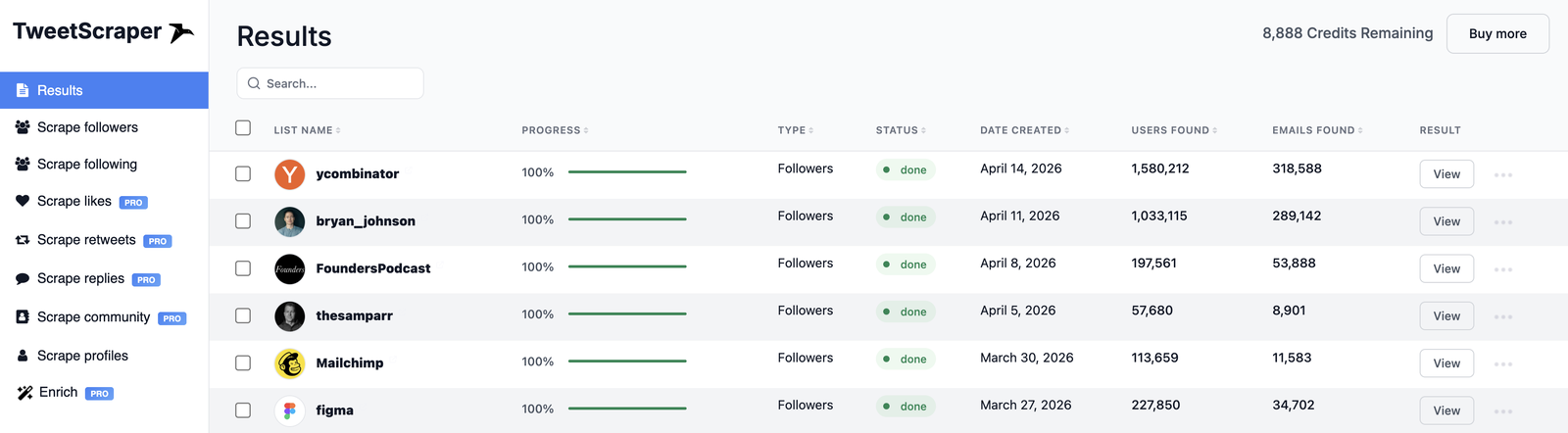
TweetScraper is a cloud email scraper built specifically for Twitter/X. Instead of filtering a database, you pick an audience - an account’s followers or following, the people who liked, retweeted or replied to a tweet, an X Community, a list, a keyword search, or your own list of handles - and it scrapes everyone in it in real time, finding contact emails for them, ready to export as a CSV.
It targets by who someone follows and engages with, which is exactly the targeting Apollo can’t do - and it never asks for your X login.
TweetScraper vs Apollo: feature by feature
Targeting: audiences vs a filter search
This is the fundamental difference. Apollo targets by attributes - title, company, industry. TweetScraper targets by audience - the actual people around an account or a tweet.
That unlocks go-to-market motions Apollo structurally can’t:
- Scrape a competitor’s followers and reach people already interested in your category.
- Scrape the likers or repliers of a viral tweet in your niche - warm, self-selected intent.
- Scrape an X Community or a curated list - often the most targeted audiences on the platform.
If your ideal customer is defined by “follows these three creators” rather than “VP of Sales at a 200-person company,” TweetScraper is the only one of the two that can build that list.
Winner: TweetScraper for audience targeting; Apollo for firmographic/title targeting.
Email data: a shared database vs real-time scraping
Apollo’s strength is verified work emails and phone numbers at scale - genuinely useful for corporate B2B. The trade-off is that it’s a shared database: the same contact is sold to every Apollo user, so those inboxes are among the most-emailed on earth, and database records drift out of date.
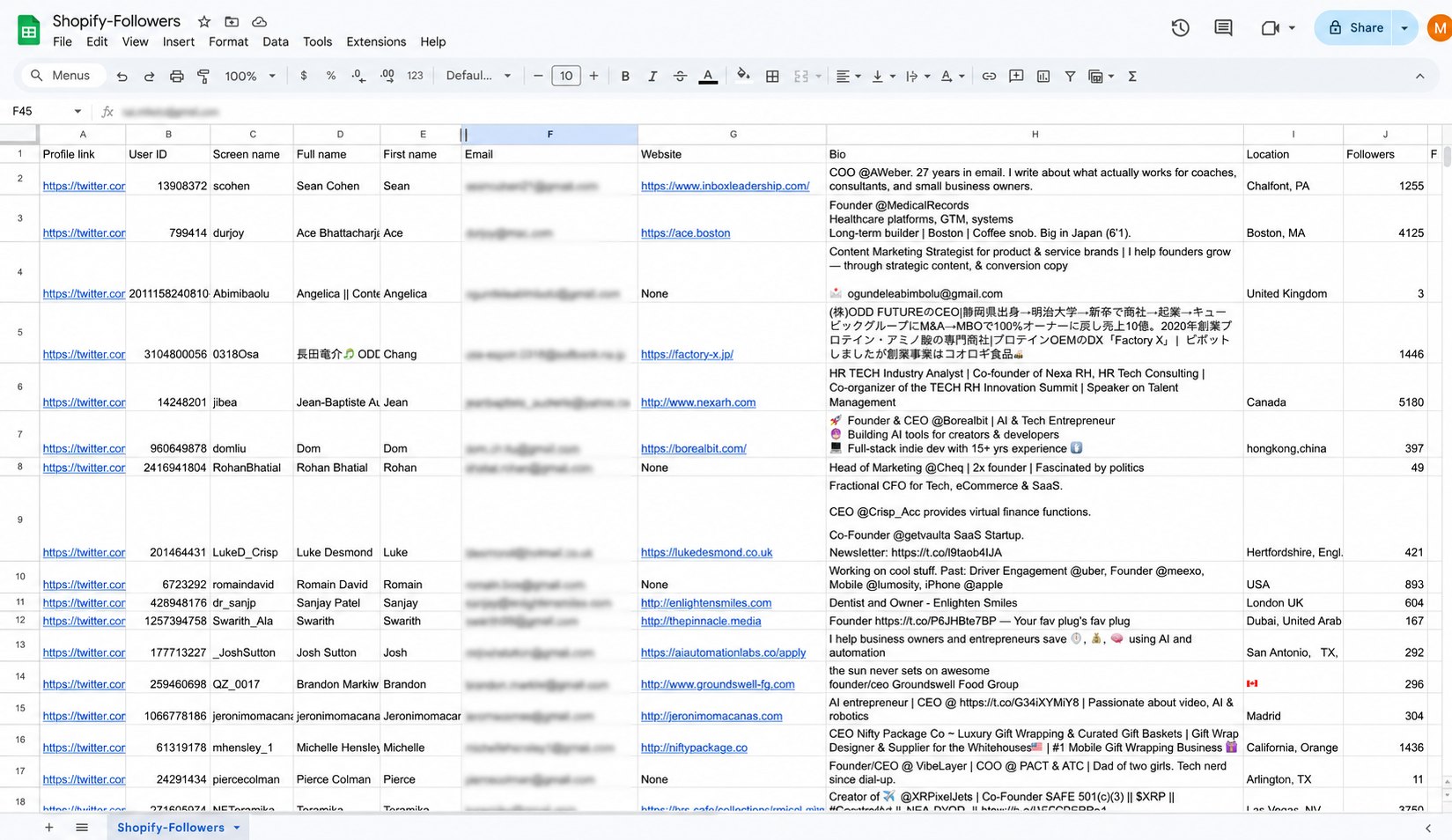
TweetScraper scrapes in real time, for the exact audience you pick - nothing comes from a stale stored record, so it reaches contacts most databases don’t have, and every row carries 14 data points for personalisation: profile link, user ID, username, full name, first name, email, website, bio, location, followers, following, tweet count, profile picture link and the source it was scraped from.
- Verified work emails and phone numbers
- Same records every other user is emailing
- Accuracy varies; data can be stale
- Scraped live the moment you run it
- Audiences no database can target
- Profile context for every lead
Winner: tie, for different jobs. Apollo for verified corporate emails; TweetScraper for reaching people by their X presence.
Who you can actually reach
Apollo’s coverage is strongest for people with a corporate footprint - a title, a company, a work email on file. It’s much thinner for the audiences that live on X: solo founders, creators, newsletter writers, agency owners, and ecom/SaaS/crypto operators. Many simply aren’t in a B2B database at all.
TweetScraper is built exactly for those people. If you sell to X-native audiences, it reaches buyers Apollo can’t see.
Winner: Apollo for corporate ICPs; TweetScraper for creators, founders and X-native niches.
Account safety
Neither tool asks you to automate your personal account for the core workflow, which is good. Apollo’s Chrome extension does run alongside your logged-in LinkedIn when you prospect there, so that activity is tied to your LinkedIn account.
TweetScraper runs entirely in the cloud and never connects to your X account, so there’s no risk of your X account being actioned no matter how much you scrape.
Winner: tie, with TweetScraper keeping your X account entirely out of it.
Pricing and value
The two charge for very different things:
- Apollo charges per seat, plus monthly credit limits for revealing and exporting contacts. A 5-person team pays five subscriptions, and heavy exporting can hit credit caps.
- TweetScraper charges per email found - 1 credit per email, never for duplicates or profiles without an email - on a single account your whole team can use, and unused credits roll over.
| Plan | TweetScraper | Apollo |
|---|---|---|
| Free | First 10 emails | ~10 exports/mo |
| Entry | $49/mo - 1,000 emails | ~$49/user/mo (annual) - ~1,000 exports/user/mo |
| Mid | $99/mo - 5,000 emails | ~$79/user/mo (annual) - ~2,000 exports/user/mo |
| Higher | $249/mo - 20,000 emails | ~$119/user/mo (annual, 3-seat min) - ~4,000 exports/user/mo |
| Largest | Up to $999/mo - 250,000 emails | Custom plan - quoted credit volumes |
At $49 for 1,000 emails, TweetScraper works out to about 5 cents per email, on one account, with no per-seat multiplier. Unused TweetScraper credits roll over; Apollo’s reset each billing cycle. (Apollo figures are approximate, per seat and based on third-party pricing breakdowns from 2026, because Apollo’s own page doesn’t list per-plan credit amounts - verify in Apollo’s plan comparison before you buy.)
Winner: TweetScraper for building lists cost-effectively, especially for small teams; Apollo if you’re already paying for its sequences, dialer and CRM.
Setup and ease of use
Apollo is a full platform: filters, saved searches, credit management, sequences, integrations and a CRM to learn. That depth is the point if you’re running outbound at scale from one tool.
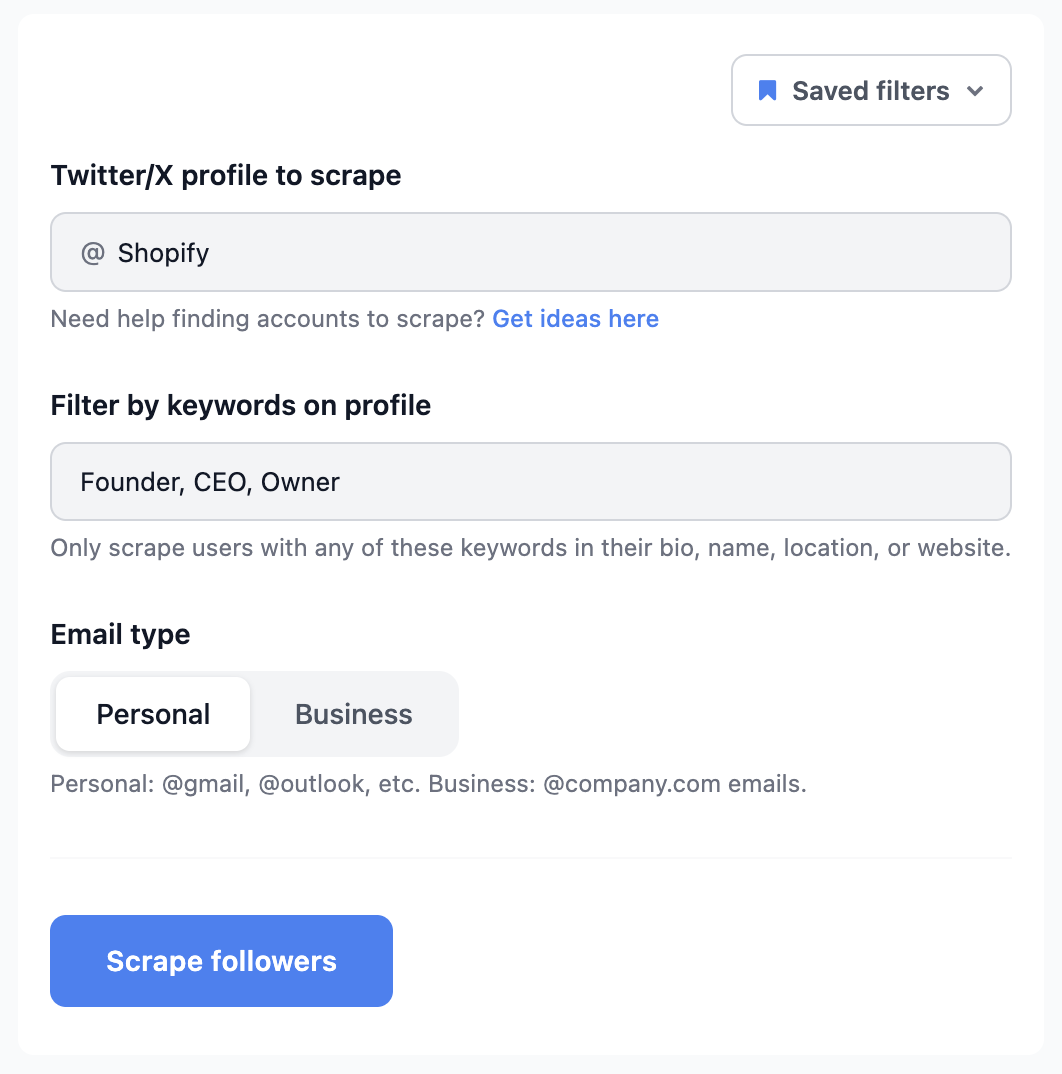
TweetScraper takes about a minute: pick a source, paste a handle or tweet, optionally filter by profile keywords like Founder or CEO and choose business or personal emails, then start.
Winner: TweetScraper for speed to a usable lead list from X; Apollo for a single hub that also runs your sequences.
When Apollo is the right choice
Apollo earns its place when your motion is classic B2B outbound: you sell to specific job titles at companies, you want verified work emails and phone numbers, and you want the sequencer, dialer and CRM in the same tool. If that’s you, TweetScraper isn’t trying to replace it - it doesn’t have a dialer or a firmographic database, and it won’t find “the CFO at a company that isn’t on X.”
Where Apollo can’t help is audience-based outreach on X. For that - a competitor’s followers, a tweet’s engagers, an X Community, or creators who simply aren’t in a B2B database - TweetScraper does the job, and many teams run both: Apollo for corporate ICPs, TweetScraper for X audiences.
How to build an X lead list TweetScraper gets you (that Apollo can’t)
- Sign up free - your first 10 emails are on us, no credit card required.
- Pick an audience Apollo can’t target: a competitor’s followers, the likers or repliers of a tweet in your niche, an X Community, or a list.
- Filter if you want - profile keywords like Founder, CEO or agency, plus business or personal emails.
- Start the scrape and export a CSV with emails and profile data.
- Import it into Instantly, Smartlead, lemlist, Apollo’s own sequencer, or your CRM.
For the full walkthrough, see how to scrape emails from Twitter. Weighing other options? Our roundup of the best Twitter email scraper tools and our TweetScraper vs PhantomBuster comparison cover the landscape.
Final thoughts
Apollo is a powerful B2B database and sales suite, and for outbound to defined corporate ICPs it’s hard to beat. But it’s a database you search by filters - it has no way to target the people who follow, like and reply on X, and it’s thin on the creators and founders who live there.
If what you need is an email list from an X audience - the whole follower base, the engagers on a tweet, a Community or a list - TweetScraper builds it in minutes, fresh at the time you run it, without touching your account. Use Apollo for the corporate ICP, TweetScraper for the X audience, or start with the one your buyers actually live in.
Start free with TweetScraper →
Frequently asked questions
Is TweetScraper a good Apollo alternative?
For Twitter/X lead generation, yes. TweetScraper targets audiences Apollo can’t - a specific account’s followers, a tweet’s likers and repliers, and X Communities - and returns contact emails for them. Apollo remains the better fit for classic B2B outbound to job titles at companies, with a database, sequencer and dialer in one tool. Many teams use both.
Can Apollo scrape emails from Twitter/X?
No. Apollo is a filter-based B2B database; it has no concept of X audiences and can’t target an account’s followers or a tweet’s engagers. To turn an X audience into an email list, you need a tool built for it like TweetScraper.
Does Apollo have emails for creators and founders on X?
Often not. Apollo’s coverage is strongest for corporate job titles at registered companies. Solo founders, creators and other X-native prospects are frequently missing from that database. TweetScraper lets you target them by their X audience instead and export the ones with a contact email.
How does TweetScraper pricing compare to Apollo?
TweetScraper starts at $49/mo for 1,000 emails (first 10 free) on a single account, and you only pay for emails actually found. Apollo is priced per seat with monthly credit limits, so a team pays per person. Verify Apollo’s current tiers on its pricing page.
Do I need to connect my X account to TweetScraper?
No. TweetScraper runs in the cloud and never asks for your X login, so there’s no risk to your X account no matter how much you scrape.
Ready to build an X lead list Apollo can’t? Scrape your first 10 emails free - no credit card, no X login.